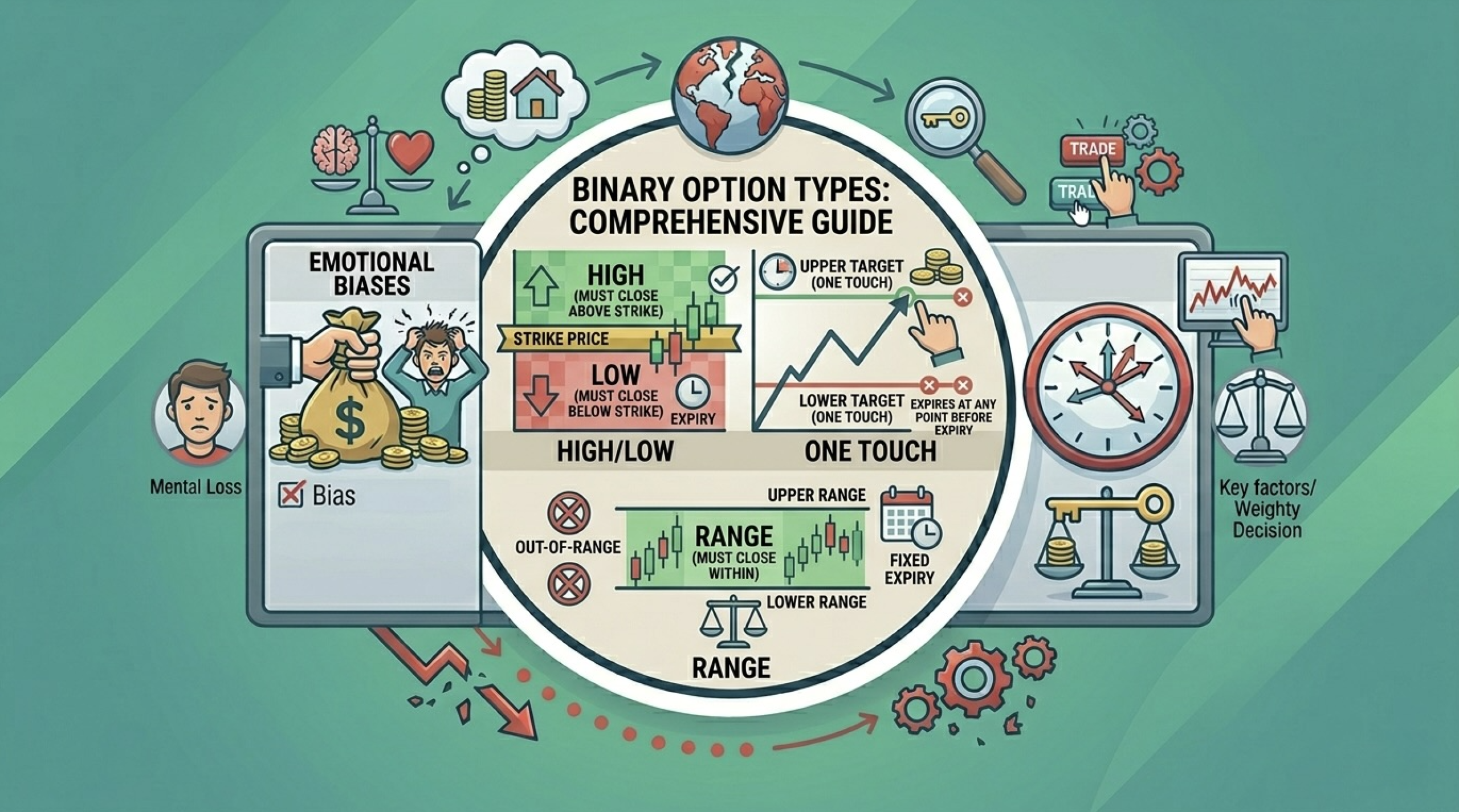
High/Low is the format that defines binary options for most retail traders. The question is always the same: will this price be above or below its current level at a specific point in the future? The strike price is the live price at the moment you open the trade, and the only thing that determines your outcome is whether the asset closes above or below that level at expiry.
How to Trade High/Low
Open a CALL if you believe the price will be higher at expiry. Open a PUT if you believe it will be lower. Your strike is set automatically at your entry price. The size of the price movement is completely irrelevant — even a single pip above the strike at expiry is a win on a CALL trade.
Most experienced traders using High/Low options focus on two things: choosing assets with higher payout rates (minimising the mathematical disadvantage) and timing entries at technically significant price levels such as support and resistance zones, moving average touches, or consolidation breakouts. This gives the strike price a logical basis rather than placing it at a random mid-move level.
Gold (XAU/USD) is at $2,348.00 and has just bounced from a key support at $2,344. You open a CALL with a 15-minute expiry at a payout of 86%.
At expiry, Gold is at $2,351.40 — 3.40 above your strike. Result: Win. +86% profit on stake.
If Gold had finished at $2,347.90 — just 10 cents below strike — you would have lost your entire stake. The margin between winning and losing is always the same: one pip in either direction.
- Simplest possible mechanics — one decision
- Available on every platform and every asset
- Short expiries allow rapid feedback on analysis
- No need to predict magnitude — only direction
- Payout below 100% creates built-in house edge
- Cannot exit early — locked until expiry
- Very short expiries are close to random
- Even correct analysis can lose by one pip
Best Used When
You have a clear directional view based on a specific chart pattern, indicator signal, or support/resistance level. High/Low is at its most rational when the trade has a logical basis — not when you are simply guessing or reacting to price movement already in progress. On platforms like Pocket Option and Quotex, High/Low is the default format and where most traders spend the majority of their time.
One Touch is fundamentally different from High/Low in one critical way: the timing of the price movement matters much less. In High/Low, the price must be at the right level at one precise instant. In One Touch, you simply need the price to visit your target at any moment during the trade’s life. This makes the winning condition easier to trigger — which is why One Touch options carry significantly higher payout rates.
How the Target Level is Set
On most platforms, the broker sets the target level rather than the trader choosing it. The target is typically placed at a level that represents a meaningful price move from the current price — far enough away that reaching it is genuinely uncertain, but close enough that the trade is not purely speculative. The further the target from the current price, the higher the payout — and the less likely the price is to reach it before expiry.
Some advanced platforms allow traders to set their own target levels, though this is less common on the retail platforms most popular in emerging markets.
EUR/USD is at 1.08400. The broker offers a One Touch option with a target of 1.08750 — 35 pips away — expiring in 4 hours. Payout: 220%.
You stake $50. At any point during the next 4 hours, if EUR/USD trades at 1.08750 even for one second, you win $110 profit immediately.
EUR/USD reaches a high of 1.08740 — just 1 pip short of the target — then reverses. Trade expires as a loss. Full $50 stake lost.
Why the Payout is So Much Higher
One Touch options pay 150–400% because the probability of the price reaching a specific level — set by the broker at a distance that reflects genuine market uncertainty — is significantly lower than simply predicting direction. The broker has priced the target level to reflect the actual statistical probability of it being touched. This does not mean One Touch is a better trade — it means the higher payout compensates for the lower win probability.
- Very high payout rates — 150–400%
- Wins as soon as target is touched — no need to hold to expiry
- Useful around key technical levels or during volatility events
- Larger potential return per unit of risk
- Much harder to predict than simple direction
- Target set by broker — not always at logical levels
- Requires larger price move to win
- Not available on all platforms or all assets
When One Touch Makes Strategic Sense
One Touch is most logical when you expect a significant directional move — for example, ahead of a major economic data release (a central bank rate decision, a non-farm payrolls report) where you believe the market will make a large move in one direction. In these contexts, the higher target level becomes more achievable and the elevated payout reflects genuine opportunity rather than wishful thinking. Using One Touch on quiet, ranging markets is rarely a sound strategy. IQ Option offers One Touch options on select assets and timeframes.
Range options replace the directional question of High/Low with a volatility question. Instead of asking „will the price go up or down?”, you are asking „will this market be calm or volatile during this period?” If you believe the market will be quiet and contained, you trade in-range. If you expect a big move — in either direction — you trade out-of-range.
In-Range vs Out-of-Range
Most platforms offer both sides of a range trade. In-range (also called „Stay Between” or „Boundary In”) pays out if the price finishes between the upper and lower boundary at expiry. This is the more popular choice and suits periods of low expected volatility — quiet market sessions, pre-news consolidations, or assets known for tight price ranges.
Out-of-range (also called „Touch Either Side” or „Boundary Out”) pays out if the price breaks either boundary before or at expiry. This is typically used ahead of high-impact events expected to cause large price moves — economic data releases, central bank decisions, or major geopolitical developments.
USD/JPY is at 149.50. The broker sets a range of 149.00 (lower) to 150.00 (upper) — a 100-pip range — expiring in 2 hours. Payout: 78%.
It is a quiet Tuesday morning with no major data releases scheduled. You trade in-range for $100.
At expiry, USD/JPY is at 149.72 — well within the boundaries. Result: Win. +$78 profit.
The US Federal Reserve is announcing its interest rate decision in 30 minutes. EUR/USD is at 1.08400. The broker sets a range of 1.08000 to 1.08800. Payout for out-of-range: 180%.
You bet the announcement will cause a large move. You trade out-of-range for $50.
The Fed surprises markets with an unexpected decision. EUR/USD spikes to 1.09100 — breaking the upper boundary. Result: Win immediately. +$90 profit.
Reading Volatility — The Core Skill for Range Options
Range trading is less about reading price direction and more about reading market conditions. Key tools include: the economic calendar (knowing when high-impact events are scheduled), ATR (Average True Range) indicators to understand typical daily price movement, and an awareness of market sessions — the Asian session is typically quieter and better suited to in-range trades, while the London/New York overlap tends to produce more volatile conditions suitable for out-of-range trades.
- Does not require directional view — only volatility view
- Can profit from quiet, ranging markets
- Out-of-range suits high-impact news events
- Adds diversification to a binary options strategy
- Boundaries set by broker — may not reflect key levels
- Requires understanding of market sessions and calendars
- Less available than High/Low across platforms
- In-range payouts often similar to High/Low
All Three Types Side by Side
| Criterion | 📈 High / Low | 🎯 One Touch | ↔️ Range |
|---|---|---|---|
| What you predict | Direction at expiry | Whether a target level is touched | Whether price stays in or breaks a range |
| Payout rate | 70 – 95% | 150 – 400% | 70 – 180% |
| Win probability | ~50% (before broker edge) | Low — depends on target distance | Moderate — depends on range width |
| Difficulty | Beginner | Advanced | Intermediate |
| Key skill required | Technical analysis — direction | Strong directional conviction + timing | Volatility reading — market conditions |
| Best market condition | Any trending or directional market | High-volatility, strong trending moves | Quiet (in-range) or pre-news (out-of-range) |
| Available on | All platforms | Select platforms | Select platforms |
Which Type Should You Start With?
For almost every beginner, the answer is High/Low — and specifically, High/Low on a demo account with expiry times of 5 minutes or longer. The mechanics are the simplest, the format is available everywhere, and the feedback loop is fast enough to build experience quickly without becoming purely random noise (as 30-second trades tend to be).
One Touch becomes worth exploring once you have a working approach to market analysis and understand how to identify likely price targets based on key technical levels. The elevated payout is genuinely appealing, but it is most rational when you have a specific, higher-conviction reason to believe a large move is coming.
Range options are worth adding to your toolkit once you become comfortable reading market sessions and using an economic calendar consistently. They offer a genuinely different kind of trading logic — one based on market character rather than direction — which can be a useful counterpart to your High/Low work.
⚠ Risk Warning
All binary options types carry significant risk of financial loss. One Touch and Range options do not reduce risk relative to High/Low — higher payouts reflect lower win probabilities, not a better expected value. The majority of retail binary options traders lose money across all formats. Always practice on a demo account before trading with real funds, and never risk money you cannot afford to lose entirely.