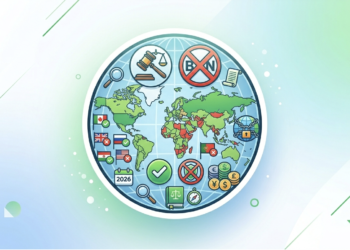
Understanding the Three Categories
Binary options are explicitly prohibited by law or by a regulator. Trading, advertising, or providing binary options services to residents is illegal. Criminal penalties may apply to operators. Offshore platforms are still technically reachable, but using them means operating in clear violation of local law.
No outright ban, but the regulator has issued public warnings, advertising bans, or partial prohibitions. Trading is tolerated or unenforced. That said, the direction is clearly negative — expect tighter rules ahead.
Binary options are legal but only through licensed providers operating under specific rules. Traders get formal investor protection. This category is genuinely rare — almost no jurisdiction currently regulates retail binary options this way.
Banned Jurisdictions
These countries have enacted explicit, permanent bans on binary options for retail investors. In most cases the ban covers both domestic providers and offshore platforms targeting residents. Criminal penalties, where they apply, are noted.
In July 2018, the European Securities and Markets Authority (ESMA) banned binary options for retail clients across the entire EU. Every national regulator followed — BaFin in Germany, AMF in France, CONSOB in Italy, CNMV in Spain, AFM in the Netherlands, KNF in Poland, and the rest. The ban is permanent and covers both domestic providers and offshore platforms actively marketing to EU residents.
ESMA’s decision came after data showed the overwhelming majority of retail binary options clients lost money. The product’s structure — where the broker always sits on the other side of the trade — made that outcome predictable. No exemptions exist anywhere in the EU. If you are a retail investor living in any EU country, binary options are simply off the table.
The FCA made binary options permanently illegal for retail consumers in January 2019 — independently of ESMA, ensuring the ban survived Brexit intact. The FCA had long viewed binary options as closer to gambling than investment, and by the time the ban arrived it had already issued hundreds of warnings against specific platforms. Criminal penalties under the Financial Services and Markets Act 2000 apply to UK-based operators.
UK residents using offshore platforms are breaking domestic financial law. Enforcement against individual traders is rare — the FCA goes after operators. But the practical reality is the same: no legal protection, no recourse if something goes wrong.
ASIC banned binary options for retail clients in May 2021 after a review found 80% of retail clients lost money. The regulator’s own words were pointed: the products were „poorly designed and sold aggressively.” The ban covers any provider — domestic or offshore — offering binary options to Australian retail investors.
ASIC is one of the more active enforcers in the region. It publicly names non-compliant platforms and has pursued offshore providers under the Corporations Act 2001. If you are Australian and trading on an offshore platform, you are exposed.
The US situation is more nuanced than a flat ban. Binary options are legal — but only on CFTC-regulated exchanges like Nadex. Every offshore platform operating without CFTC registration is illegal under the Commodity Exchange Act when it serves US residents. The CFTC and SEC have jointly pursued criminal prosecutions against offshore operators, and the FBI lists binary options fraud among its top financial crime categories.
Using an offshore binary options platform as a US resident means engaging with an unregistered entity — which is itself a violation of US law, separate from any fraud. Some US-based affiliates of offshore platforms have faced charges too. The legal risk here is real and well-documented.
Canada regulates securities at the provincial level, and most major provinces — Ontario, British Columbia, Quebec, Alberta — have banned binary options or classified them as fraud outright. The Canadian Securities Administrators (CSA) went further than most regulators: it actively pursued criminal charges against both operators and individuals running binary options schemes. Canada has prosecuted more binary options cases criminally than almost any other country.
The Ontario Securities Commission (OSC) has been especially aggressive, treating binary options fraud as a top enforcement priority for years. If you are a Canadian resident using an offshore platform, you are in violation of securities law in most provinces. Full stop.
Israel’s approach goes further than any other country. In 2017 the Knesset did not just ban binary options — it made operating them a criminal offence, regardless of who the customers are or where they live. That extraterritorial reach was a direct response to the large Israeli binary options industry that had been selling to foreign customers for years while operating out of Tel Aviv.
The ISA worked with the FBI and Europol to track operators down. Arrests, extraditions, and convictions followed. Israel is the only country in the world where running a binary options business — even if every single customer is abroad — can land you in prison under domestic law.
Japan’s FSA banned binary options for retail clients after its own review found systematic losses among Japanese investors. Both domestic providers and foreign operators targeting Japanese residents are prohibited. The FSA is technically sophisticated and monitors offshore platforms for illegal marketing activity.
MAS banned binary options for retail investors in 2018 as part of a wider crackdown on harmful leveraged products. Singapore runs one of the tightest financial regulatory regimes in Asia, and the ban fits that pattern. Offshore platforms marketing to Singapore residents without MAS authorisation breach the Securities and Futures Act.
South Korea’s FSC and FSS have banned binary options for retail clients and take enforcement seriously. The regulators routinely block offshore platforms at the network level — not just issue warnings — and pursue legal action against providers targeting Korean residents. It is one of the more technically capable enforcement operations in Asia.
New Zealand’s FMA banned binary options for retail investors, aligning with Australia next door. The FMA publishes regular warnings against specific offshore platforms and coordinates with international regulators on enforcement. Smaller market, but the ban is genuine and monitored.
FINMA classifies binary options as financial products that require authorisation to offer. Since no provider has that authorisation, the product is effectively banned for Swiss retail investors without a formal legislative ban ever being needed. FINMA’s enforcement track record is strong, and the practical outcome for Swiss residents is the same as in neighbouring EU countries.
China bans binary options and backs it up with network-level blocking. Most offshore platforms are simply unreachable from mainland China without a VPN. Beyond the binary options prohibition, SAFE regulations restrict foreign exchange outflows for speculative purposes — so even if you could reach a platform, funding the account legally would be another problem entirely.
If You Are in a Banned Jurisdiction
Using an offshore binary options platform from a banned country puts you in violation of domestic law. Enforcement against individual retail traders is uncommon — regulators usually go after operators. But that is not the point. Any money you have sitting with an offshore broker has zero legal protection. You cannot recover it through domestic courts. If the platform disappears tomorrow, your options are limited to filing a complaint with an offshore regulator that has no obligation to help you. The risk is real. The protection is nonexistent.
Restricted Jurisdictions
These countries have not banned binary options outright, but their regulators have issued warnings, advertising restrictions, or partial prohibitions. Trading is technically accessible. Legal consequences for individual traders are unlikely. That does not mean it is safe — it means the regulator has not gotten around to it yet, or has chosen warnings over legislation for now.
India is complicated. SEBI has not explicitly banned binary options, but the problem lies elsewhere — in the Foreign Exchange Management Act (FEMA), administered by the RBI. FEMA bars Indian residents from sending money to offshore platforms for speculative trading. That makes funding a binary options account a FEMA violation, regardless of what you think about binary options themselves.
In practice, millions of Indian traders get around this via cryptocurrency deposits. Enforcement at the individual level has been limited. But the Enforcement Directorate has been stepping up actions in recent years, and the legal exposure is real even if prosecutions are rare.
Indonesia’s OJK has put out multiple warnings against binary options platforms and, in some official communications, called them gambling — which would make them illegal under existing statutes. No formal ban has been passed, but OJK has blocked specific platforms and keeps adding names to its public alert list. The direction is clearly toward tighter restrictions, not looser ones.
Malaysia’s Securities Commission has stated clearly that binary options are not approved financial instruments for retail investors and that no provider is authorised to offer them. There is no legislative ban yet, but the SC publishes a warning list that includes a long string of binary options platforms. The message is clear even if the law has not caught up to it.
Thailand’s SEC has warned investors against binary options platforms and stated that no provider is licensed to operate in the country. No formal ban exists, but the SEC has been explicit: there is no legal protection for Thai traders using these platforms. You trade, you’re on your own.
Morocco’s AMMC has issued investor warnings and stated that no binary options provider is authorised to operate in the country. The regulator’s public alert list includes numerous platforms. No formal ban, but advertising restrictions apply to unlicensed providers — and all binary options providers operating in Morocco are unlicensed.
Colombia’s SFC has warned against specific binary options platforms and told investors they are not authorised to operate in the country. No comprehensive ban has been passed, but the SFC has been more active than most Latin American regulators in pursuing unlicensed platforms — and the pressure is building.
Regulated Jurisdictions
Genuine regulatory frameworks for retail binary options are almost nonexistent globally. The two cases below are the only ones worth discussing — and one of them no longer applies.
The US is the only major jurisdiction where retail binary options remain legal — but only through Nadex, a CFTC-regulated exchange. Nadex is a fundamentally different product from anything an offshore platform offers. Contracts are standardised, pricing is transparent, and the exchange does not trade against you. That last point matters enormously: on offshore platforms, the broker is always your counterparty. On Nadex, it is not.
US residents who want to trade binary options legally must use Nadex or another CFTC-registered venue. That is the only route. There are no exceptions.
For years, Cyprus was the licence of choice for binary options platforms. CySEC issued licences under MiFID, which gave these businesses a veneer of European legitimacy and helped them expand globally. That ended in 2018 when ESMA’s ban superseded all national frameworks — including CySEC’s. Binary options are now banned in Cyprus like everywhere else in the EU.
The legacy of this period still shows up today. Many offshore platforms still display old CySEC licence numbers in their footers or marketing. Those licences no longer authorise binary options offerings to retail clients anywhere in the EU. If a broker is pointing to a CySEC licence to justify their binary options product, treat that as a red flag, not a reassurance.
Summary — All Major Jurisdictions
A quick-reference overview of every jurisdiction covered in this guide.
| Country / Region | Status | Regulator | Key Note |
|---|---|---|---|
| 🇪🇺 European Union (all 27) | Banned | ESMA + national | Permanent ban since 2018 |
| 🇬🇧 United Kingdom | Banned | FCA | Permanent since January 2019 |
| 🇦🇺 Australia | Banned | ASIC | Permanent since May 2021 |
| 🇺🇸 United States | Banned (offshore) | CFTC + SEC | Legal only on Nadex (CFTC) |
| 🇨🇦 Canada | Banned | CSA + provincial | Criminal charges have been laid |
| 🇮🇱 Israel | Criminalised | ISA | Most severe ban globally |
| 🇯🇵 Japan | Banned | FSA Japan | Retail ban — active enforcement |
| 🇸🇬 Singapore | Banned | MAS | Since 2018 |
| 🇰🇷 South Korea | Banned | FSC / FSS | Network blocking in place |
| 🇳🇿 New Zealand | Banned | FMA NZ | Retail ban — international enforcement |
| 🇨🇭 Switzerland | Banned | FINMA | Effectively banned via licensing |
| 🇨🇳 China | Banned | CSRC + SAFE | Network-level blocking (GFW) |
| 🇮🇳 India | Restricted | SEBI + RBI | FEMA restricts funding of offshore accounts |
| 🇮🇩 Indonesia | Restricted | OJK | Classified as gambling by some authorities |
| 🇲🇾 Malaysia | Restricted | SC Malaysia | Investor warnings — no licence possible |
| 🇹🇭 Thailand | Restricted | SEC Thailand | Warnings issued — unapproved product |
| 🇲🇦 Morocco | Restricted | AMMC | Investor warnings — advertising restricted |
| 🇨🇴 Colombia | Restricted | SFC | Platforms warned — unlicensed |
| 🇺🇸 USA — Nadex only | Regulated | CFTC | Exchange-traded only — full protection |
The Direction Is Not Ambiguous
Every major jurisdiction that has taken a hard look at binary options over the past decade has responded the same way: a ban or serious restrictions. Not one has gone the other direction — loosening rules or building new retail frameworks. If you are trading in a country where binary options are currently accessible simply because no one has passed a law yet, that gap is closing. The question is when, not whether.
Where Binary Options Remain Accessible
Large parts of Sub-Saharan Africa, the Middle East, Central Asia, and Latin America have no specific binary options legislation. These are not regulated markets — they are unaddressed ones. Regulators in these countries have other priorities or have not yet turned their attention to the product. Accessible does not mean protected. Traders in all of these markets using offshore platforms have no domestic legal recourse if a broker defaults, delays withdrawals, or closes down. Your only protection is the quality of the broker’s offshore licence — and how seriously that licence is actually enforced.
⚠ Risk Warning
Binary options are high-risk speculative instruments. Even in jurisdictions where they are legally accessible, they carry no domestic investor protection for offshore trading. The majority of retail traders lose money. Never trade with money you cannot afford to lose entirely. Always start on a free demo account.