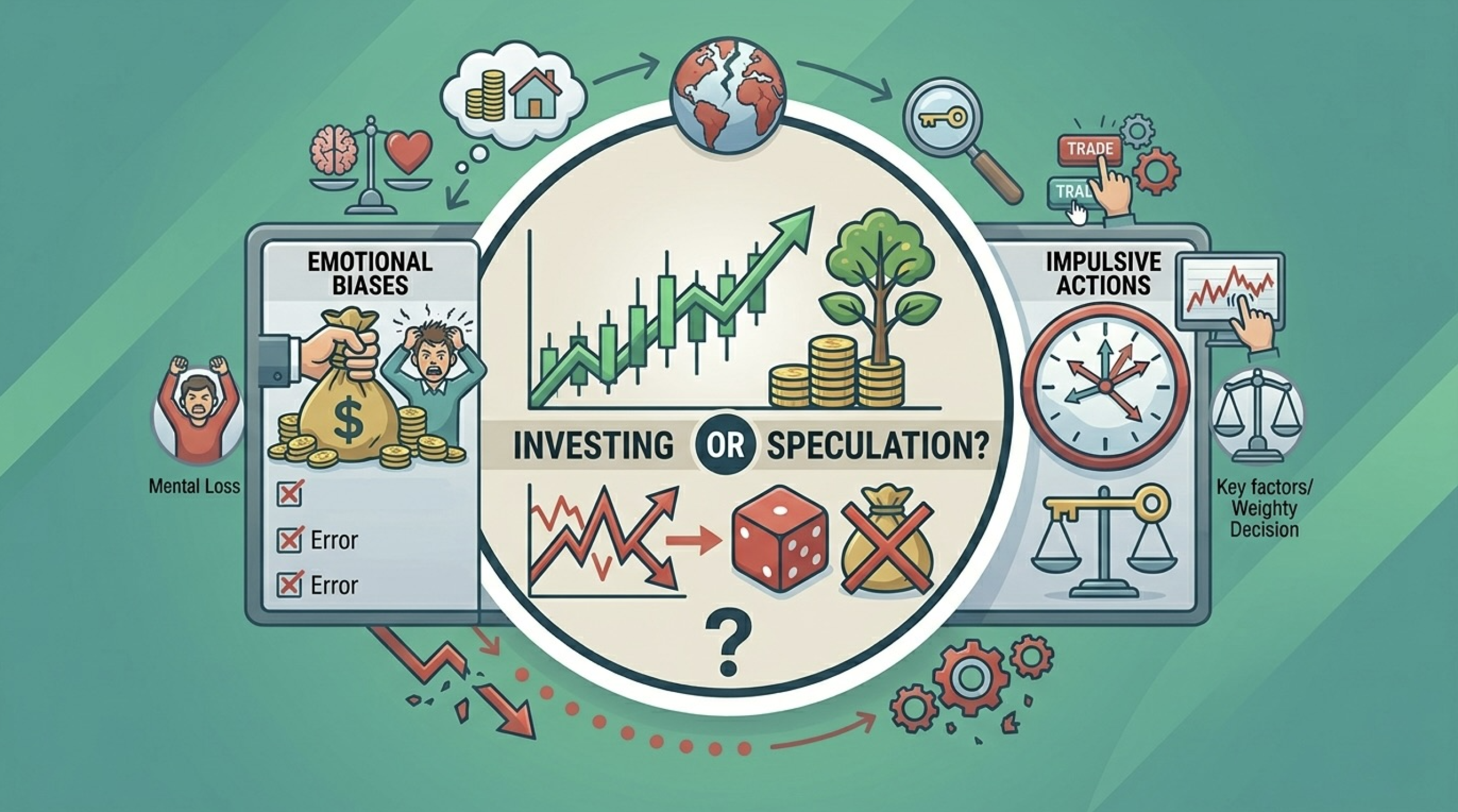
What Separates Investing from Speculation
Before we can answer the question, we need clear definitions. These two words are used interchangeably in casual conversation but mean fundamentally different things in finance. The distinction goes back well over a century — Benjamin Graham, the father of value investing, drew the line clearly in 1934 and the definition remains the most useful one available.
An investment operation is one which, upon thorough analysis, promises safety of principal and an adequate return. Operations not meeting these requirements are speculative.
Investing involves committing capital to an asset that generates value over time — through earnings, dividends, interest, or appreciation tied to real economic activity. The investor expects a positive return as compensation for providing capital to a productive enterprise.
- Buying shares in a company and holding for dividends and growth
- Purchasing a government bond for fixed interest income
- Buying sukuk backed by real productive assets
- Real estate investment for rental yield and capital gain
Speculation involves attempting to profit from short-term price movements without regard for underlying value. The speculator accepts higher risk for the possibility of higher short-term gain — but holds no claim on any productive asset.
Speculation is not inherently wrong or irresponsible — but it is a fundamentally different activity from investing, with different risk management requirements and different expectations about long-term outcomes.
- Trading currency pairs for short-term price movements
- Buying commodities to profit from price volatility
- Short-term CFD positions on indices or stocks
- Binary options on any asset at any expiry
The Honest Answer
Let’s apply Graham’s definition directly. Does binary options trading, upon thorough analysis, promise safety of principal and an adequate return? It does not — and on every criterion, it fails the test of investment.
When you buy a share of stock, you own a proportional claim on a real company’s assets and future earnings. The value of that share is ultimately tied to whether the company generates economic value. When you open a binary option, you own nothing. You hold a temporary contract against a broker, with a fixed expiry and a fixed payout — and the payout is mathematically structured so that the broker retains a profit margin on every trade placed, regardless of the market outcome.
„In investing, capital flows to productive enterprise and generates real returns. In binary options, capital flows to a broker — who profits whether you win or lose.”
Why Binary Options Sit Closer to Gambling Than Speculation
Even within the category of speculation, binary options occupy an extreme position. Traditional speculation — forex trading, CFD trading, commodity futures — shares certain structural characteristics with investing: positions can be held for variable durations, losses can be managed with stop-loss orders, position sizes can be calibrated to risk tolerance, and skill in analysis can produce a genuine statistical edge over time.
Binary options strip away most of these characteristics. The duration is fixed. You cannot exit early. You cannot manage the size of your loss once the trade is open. The outcome is determined by a single instant in time rather than a sustained price movement. And the payout structure — where wins pay less than the stake you risk — creates a negative expected value that no amount of skill can fully overcome unless your win rate consistently exceeds the break-even threshold.
The Financial Instrument Spectrum
It helps to visualise where different financial activities sit on the spectrum from conservative investment to pure chance. Binary options do not sit at the extremes — they are not as safe as bonds, nor are they as purely random as a roulette wheel. But they sit decisively in the speculative-to-gambling zone.
The critical difference between binary options and casino gambling is that binary options do allow for some degree of skill-based advantage. A trader who understands technical analysis, reads chart patterns accurately, and trades at technically significant levels can shift their win rate above the break-even threshold — something a roulette wheel does not permit.
But that potential edge is narrow, difficult to sustain, and constantly eroded by the payout structure. The closer binary options sit to the break-even line, the more they resemble skill-based speculation. The further below it, the more they resemble gambling. For the majority of retail traders, the evidence suggests the latter is the more accurate description of their actual experience.
Does That Mean Binary Options Are Wrong?
This is where the conversation becomes more nuanced — and more honest. Calling binary options speculation or even gambling is not a moral condemnation. Speculation has an entirely legitimate role in financial markets and in personal finance. The problem is not what binary options are; it is when people misunderstand what they are.
The Real Problem
Binary options become genuinely harmful when traders approach them as a source of income, a retirement strategy, or a wealth-building tool. They are none of those things. Their structure makes sustained profitability extremely difficult. The harm comes from misalignment between expectation and reality — not from the activity itself, for a person who understands exactly what they are doing.
If you trade binary options with a small, genuinely discretionary amount of capital — money you could lose entirely without affecting your life — with the understanding that you are engaging in high-risk speculation and using it primarily to develop market analysis skills, that is a defensible approach. Many traders have used binary options as a low-cost entry point to learning how markets move before progressing to forex or CFD trading with proper risk management tools.
Where it goes wrong is when binary options become a replacement for real financial planning. When the family savings are at stake. When the goal is to „make money fast.” When the outcome of one trade determines whether this month’s rent is paid. At that point, the activity has crossed from calculated risk into genuine harm — and no platform, broker, or strategy can fix that.
What Serious Traders Do Instead
Traders who start with binary options and want to progress toward genuinely skill-based financial activity typically make one of two transitions:
Forex trading preserves the speed and accessibility of binary options while adding essential tools: variable position sizing, stop-loss orders, early exit options, and the ability to profit proportionally from the size of a price move. The mathematical edge available to a skilled forex trader is meaningfully greater than what binary options permit — because the profit on a winning trade is not capped by a broker-set payout percentage.
Long-term equity investing — through stock markets like Tadawul, or through globally diversified ETFs — represents a genuine shift from speculation to investment. Here, capital is committed to real companies generating real economic value, over time horizons where the long-term positive expected value of markets works in the investor’s favour rather than against them.
The Honest Use Case for Binary Options
If you understand that binary options are high-risk speculation, treat them accordingly, allocate only a small fraction of your disposable income to them, and use them as a learning environment rather than a wealth-building tool — there is nothing inherently wrong with trading them where they are legally accessible. The key is honest self-assessment: are you treating this as entertainment and education, or are you treating it as a financial strategy? The first is defensible. The second is not.
⚠ Risk Warning
Binary options are high-risk speculative instruments, not investments. The majority of retail traders who trade binary options lose money. The payout structure creates a built-in negative expected value. Binary options are banned for retail investors in the EU, UK, Australia, and other regulated markets because of the harm they have demonstrably caused. Never trade with money you cannot afford to lose entirely. Always start on a demo account.