What Are Binary Options and How Do They Work?
The Core Concept
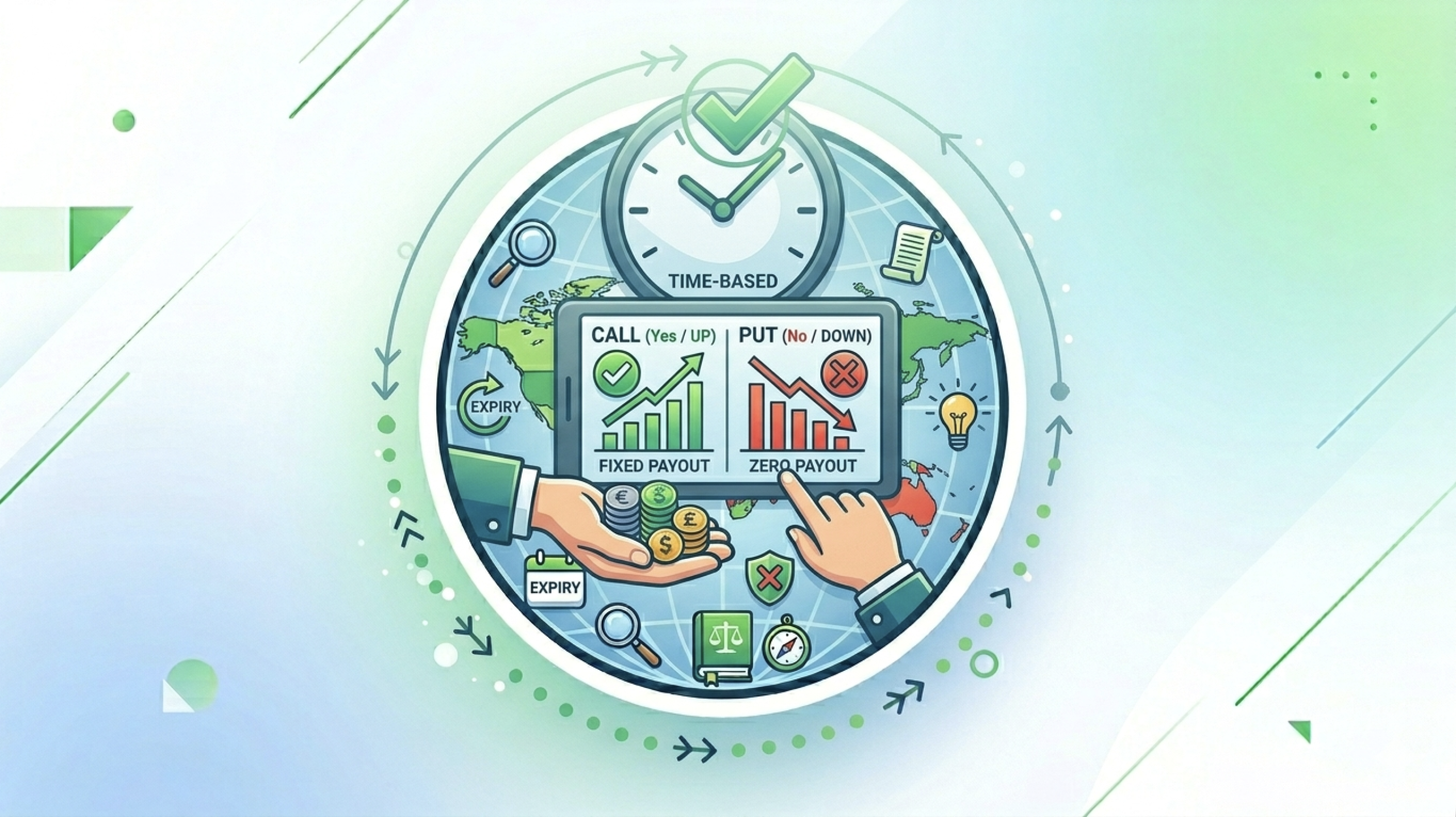
A binary option is a contract with exactly two possible outcomes at expiry: you either receive a predetermined profit, or you lose the amount you staked. There is no middle ground. The word „binary” refers directly to this two-outcome structure — it comes from the Latin binarius, meaning „consisting of two.”
Unlike traditional investing — where you buy a stock and your profit or loss depends on exactly how much the price moves — a binary option pays the same fixed amount regardless of whether the price moves one pip or one hundred pips in your favour. The only thing that matters is the direction: up or down relative to the strike price at the moment the option expires.
Simple Definition
A binary option is a question: „Will this asset be above [price X] at [time Y]?” Answer correctly → you win a fixed payout. Answer incorrectly → you lose your stake. The magnitude of the price movement is irrelevant.
How a Binary Options Trade Works — Step by Step
Choose Your Asset
Select what you want to trade. Binary options platforms typically offer currency pairs (forex), commodities like gold and oil, stock market indices such as the S&P 500, and individual company stocks. Some platforms also offer cryptocurrency pairs.
Set Your Expiry Time
Choose when your trade expires — this could be as short as 30 seconds or as long as several hours. At the moment of expiry, the platform compares the asset’s current price to the price at the moment you opened the trade (the „strike price”).
Predict the Direction
Choose CALL if you believe the price will be higher than the current level at expiry. Choose PUT if you believe the price will be lower. This is the only decision that matters for the outcome of the trade.
Enter Your Stake Amount
Decide how much to invest in this trade. On most platforms the minimum is $1–$5. The payout percentage is shown before you confirm — for example „82% payout” means if your $100 trade wins, you receive $182 total ($100 stake returned plus $82 profit).
Wait for Expiry
Once you confirm the trade, the contract is active. At the exact moment of expiry, the outcome is determined by comparing the asset’s closing price to the strike price. There is nothing you can do to influence the result — the trade either wins or loses.
Receive Your Result
If your prediction was correct, the payout is credited to your account instantly. If incorrect, your staked amount is deducted. Some platforms offer a small „refund” of 10–15% on losing trades, which effectively reduces the payout on winning trades to compensate.
A Real Trade Example
Let’s walk through a concrete example to make the mechanics completely clear.
Notice the asymmetry: you risk $100 to potentially win $85. This means even with a 50% win rate you would be losing money over time. To break even with an 85% payout, you need to win more than 54% of your trades. This is the fundamental mathematical challenge of binary options trading.
Types of Binary Options
High/Low (Call/Put)
The most common type. You predict whether the asset price will be higher (CALL) or lower (PUT) than the current price at expiry. This is the format offered by the vast majority of platforms targeting retail traders in Africa, Asia, and the Middle East.
One Touch
You predict whether the asset price will touch a specific target level at any point before expiry — not necessarily at the exact expiry moment. If the target is reached even briefly, the trade wins. Higher payouts (sometimes 200%+) reflect the higher difficulty of predicting a specific target level.
Range / Boundary
You predict whether the asset price will stay within a defined range or break outside it before expiry. Suitable for periods of low expected volatility (stay inside) or high expected volatility (break outside). Less common on retail platforms.
60-Second Options
A variation of high/low with an expiry of just 60 seconds. Extremely popular with new traders due to the rapid feedback loop — but also the most dangerous, as it encourages high-frequency, impulsive trading rather than analysis-based decision-making.
What Can You Trade?
Modern binary options platforms offer a wide range of underlying assets across four main categories:
- Forex pairs — EUR/USD, GBP/USD, USD/JPY, USD/ZAR, and many others. The most actively traded category on retail binary platforms.
- Commodities — Gold (XAU/USD), Silver, Crude Oil (WTI and Brent), Natural Gas. Particularly popular with traders in commodity-producing regions.
- Stock market indices — S&P 500, NASDAQ 100, FTSE 100, DAX, Nikkei 225. Allow you to trade the direction of entire markets rather than individual companies.
- Individual stocks — Apple, Tesla, Amazon, Google, and others on select platforms. Less common on offshore binary platforms.
- Cryptocurrencies — Bitcoin, Ethereum, and major altcoins on platforms that have added crypto to their asset list.
How the Broker Makes Money
Understanding the broker’s business model is essential to understanding why binary options trading is difficult to profit from consistently. The key is the payout structure.
When you trade on a binary options platform, the platform is effectively taking the opposite side of your trade. If you stake $100 on a CALL with an 85% payout rate, the platform is betting $85 against your $100. The „house edge” is built into the payout asymmetry.
The Math of the House Edge
With an 85% payout, on every $100 of trades placed: you expect to receive $85 when you win and lose $100 when you lose. With a 50% win rate that is theoretically the best you can achieve through guessing, you lose $7.50 per $200 traded — a 3.75% house edge per trade. The platform keeps that margin regardless of which way the market moves.
This is why it is mathematically impossible to profit from binary options over the long term without a genuine analytical edge that produces win rates significantly above 54–56% — which is a high bar that few retail traders consistently achieve.
Advantages and Disadvantages
- Simple structure — only two possible outcomes
- Fixed risk — you can never lose more than your stake
- Low minimum deposits — some platforms start at $1
- Wide asset choice — forex, commodities, indices, crypto
- Short trade durations — results in minutes or seconds
- No requirement to own the underlying asset
- Available 24/7 on cryptocurrency pairs
- Accessible on mobile with low-data apps
- Negative expected value — the payout maths favour the broker
- Total loss of stake on every losing trade
- Banned in EU, UK, Australia and many regulated markets
- Mostly offered by offshore, lightly regulated brokers
- No position management — you cannot exit early in most cases
- Short expiries encourage impulsive, emotional trading
- High prevalence of scam platforms in unregulated markets
- Difficult to build consistent profitability long-term
Where Are Binary Options Available?
Binary options are a globally traded instrument, but their legal status varies dramatically by country. Some jurisdictions have explicitly banned them for retail investors; others have no specific regulation at all, leaving them in a grey zone where they are accessible but not formally supervised. Understanding the regulatory landscape of your country before trading is essential.
Why Availability Varies So Much
Binary options were banned in the EU, UK, and Australia after regulators found that the overwhelming majority of retail traders lost money — and that the product structure inherently favoured the broker. In countries without dedicated financial regulators or where retail investor protection legislation has not yet caught up, binary options remain accessible through offshore-licensed platforms.
No specific binary options legislation in most countries. Traders access offshore-regulated platforms without restriction. South Africa is the most regulated market on the continent (FSCA), but binary options are not explicitly prohibited.
No outright ban exists in GCC states or most of North Africa. Traders use offshore-regulated international brokers. Islamic swap-free accounts are widely available to address Sharia compliance concerns. The UAE (DFSA) and Qatar (QFCRA) have the most developed regulatory frameworks in the region.
Binary options are accessible across most of Southeast and Central Asia through international platforms. India is a notable grey zone — forex and derivatives trading is restricted onshore, but offshore platforms serve Indian traders widely. China blocks most foreign platforms at the network level.
No country in Latin America has a blanket ban on binary options comparable to the EU or UK. Brazil has the most developed financial regulatory framework (CVM) but has not explicitly prohibited binary options for retail investors. Offshore platforms operate freely across the region.
❌ Where Binary Options Are Banned
Binary options are explicitly prohibited for retail investors in: European Union (all 27 member states, ESMA permanent ban), United Kingdom (FCA ban since 2019), Australia (ASIC ban since 2021), Canada (most provinces), United States (illegal outside CFTC-regulated exchanges), Israel (banned and criminalised), Japan, and Singapore. Traders based in these countries cannot legally access binary options through any broker, domestic or offshore.
Binary Options vs. Forex Trading
Many new traders confuse binary options with forex trading. They involve some of the same underlying assets — EUR/USD, for example, appears on both — but they are fundamentally different products with very different risk profiles.
In forex trading, you buy or sell a currency pair and your profit or loss depends on how far the price moves in your favour. You can set stop-loss orders, manage position sizes, and exit trades at any time. In binary options, none of that applies: the outcome is fixed, the duration is fixed, and your only decision is direction.
Forex trading, while carrying its own significant risks, offers more tools for risk management and a more flexible trading environment. Binary options offer simplicity and low entry requirements, but with a built-in mathematical disadvantage that makes long-term profitability challenging.
⚠ Risk Warning
Binary options are high-risk speculative instruments. The majority of retail traders who trade binary options lose money. The payout structure is mathematically designed to favour the broker — achieving consistent profitability requires a win rate significantly above 50%, which is difficult to sustain over time.
Binary options are banned in the EU, UK, Australia, Canada, and the United States specifically because of the harm they have caused retail investors. If you choose to trade them, do so only with money you can afford to lose entirely, always use a licensed and regulated broker, and treat it as speculative activity — not as a source of income.