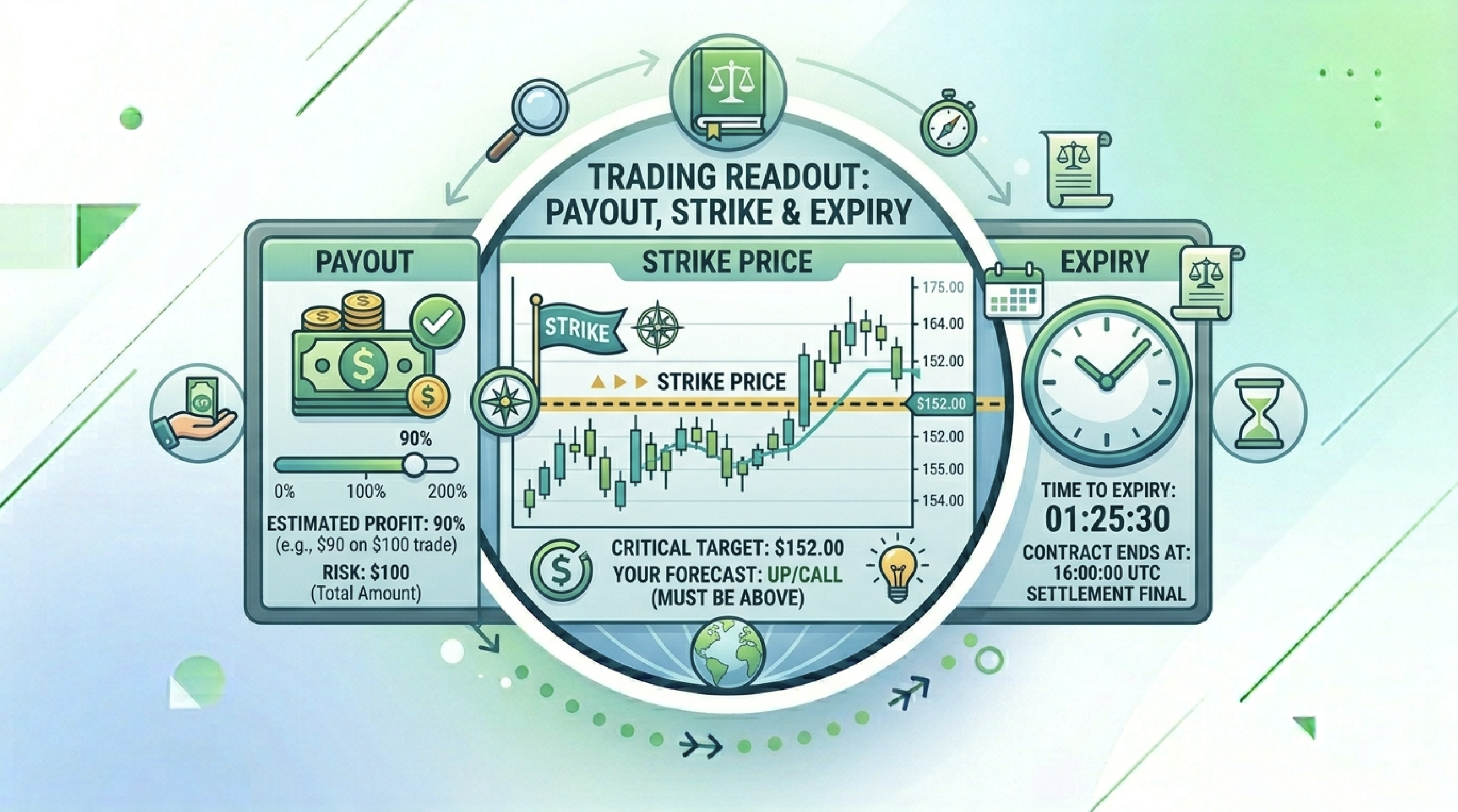
The payout percentage is set by the broker and displayed clearly before you confirm any trade. It is not fixed across all assets or all platforms — payouts vary depending on the asset, the expiry time, and current market conditions. On most platforms like Pocket Option or Quotex, payouts typically range from 70% to 98% depending on these factors.
What the payout does not tell you is what happens if you lose. On a standard binary option, a losing trade results in the complete loss of your entire stake — not just a portion. Some platforms offer a small „refund” of 5–15% on losing trades, but this is always accompanied by a reduced payout on winning trades to compensate.
Payout Math — What You Actually Need to Win
Example: With an 85% payout → 100 ÷ 185 = 54.1% — you must win more than 54.1% of trades to be profitable. With a 70% payout → you need to win more than 58.8% of trades. Always check this number before trading an asset. Higher payouts are not just more attractive — they are mathematically more forgiving.
What Affects the Payout Rate?
- The asset: Major forex pairs like EUR/USD typically offer lower payouts than more volatile assets like crypto pairs, because price direction is easier to analyse and therefore easier to predict.
- The expiry duration: Very short expiries (30–60 seconds) often carry higher payouts to compensate for the increased randomness. Longer expiries may offer lower payouts but more time for analysis.
- Market conditions: Some platforms dynamically adjust payouts based on real-time volatility and the balance of CALL vs PUT bets being placed by traders.
- The broker’s margin: Each broker builds its own profit margin into the payout structure. Quotex advertises payouts up to 98% on premium assets, while other platforms cap theirs at 80–85%.
The strike price is always the current market price — it is set automatically by the platform the instant you confirm the trade. You do not choose a strike price; it is determined by the live market feed at the precise moment your order is executed. This is an important distinction from other types of options trading where the strike is pre-selected from a list of levels.
On most retail platforms like IQ Option and Pocket Option, the strike price is displayed prominently on the trade confirmation screen. Once confirmed, it is locked — it does not change regardless of where the price goes during the life of the trade.
Why the Strike Price Matters
Understanding the strike price helps you time your trade entries more precisely. Consider these two scenarios:
- You are trading EUR/USD and price is currently at 1.08460, having just bounced off a support level at 1.08400. You open a CALL. Your strike is 1.08460. The price only needs to stay above 1.08460 at expiry — even by a single pip — for you to win.
- You wait five minutes and the price rises to 1.08520 before you enter. Now your strike is 1.08520 — 60 pips higher — and the market now has to sustain that higher level at expiry. A small pullback that previously would have still kept you in profit now knocks you out.
Timing your entry — and therefore controlling your strike price — is one of the few genuine levers available to binary options traders. Entering at a technically significant level (a support bounce, a breakout retest, a moving average) gives the trade a stronger logical basis than entering at a random mid-move price.
In the Money vs Out of the Money
A trade is in the money (ITM) when the current price is on the correct side of the strike — meaning if it expired now, you would win. A trade is out of the money (OTM) when it would currently lose. Watching your trade move from OTM to ITM (or vice versa) as the expiry approaches is one of the most stressful — and instructive — aspects of binary options trading.
Slippage and Execution
On fast-moving markets, there can sometimes be a slight difference between the price displayed when you click „trade” and the price at which your order is actually executed. This is called slippage and it means your strike price may be marginally different from what you expected. On reputable platforms this is rare and usually minimal — but it is a reason to be particularly careful during major news events when prices move extremely fast.
Expiry times vary enormously across platforms. Most retail binary options platforms offer a range from as short as 30 seconds to as long as several hours. The expiry you choose has a profound effect on the risk level of your trade and the type of analysis that is useful.
Short Expiries (30 seconds – 1 minute)
These are the most popular expiry times among new traders — and the most dangerous. At 30–60 seconds, price movements are essentially random noise. No technical indicator, chart pattern, or news event gives you a reliable edge at this timeframe. The outcome is closer to a coin flip than a skill-based decision. While they are exciting and produce rapid feedback, they are the format most likely to encourage impulsive, loss-chasing behaviour.
Medium Expiries (5 – 15 minutes)
At 5–15 minutes, basic technical analysis begins to have more meaningful input. Short-term momentum indicators, recent price action, and support/resistance levels at the 1-minute or 5-minute chart timeframe become relevant. Most experienced binary options traders operate in this range — short enough for multiple trades per session, long enough for the analysis to carry some weight.
Longer Expiries (30 minutes – 4 hours)
Longer-duration binary options allow for more substantive analysis including trend direction, key chart patterns, and even fundamental factors like scheduled economic data releases. The trade lasts long enough for your reasoning to play out — but also long enough for unexpected events to reverse what looked like a clear setup. These expiries suit traders with a more patient, analytical approach.
The Expiry Timing Trap
One of the most common beginner mistakes is choosing an expiry time based on impatience rather than strategy. „I want to know the result faster” is not a trading reason. Your expiry time should be determined by your analysis: how long does it typically take for your setup to play out? If you’re trading a 5-minute momentum signal, a 5-minute expiry makes sense. If you’re trading a breakout from a daily level, a 5-minute expiry makes no sense at all.
How Payout, Strike, and Expiry Work Together
These three elements do not exist in isolation — they interact to define the complete risk-reward profile of every trade. Here is a worked example showing how changing one element changes everything.
Now notice what happens if the broker changes one variable. Same trade, same direction, same stake — but a different payout rate of 72% instead of 88%. Your winning trade now pays only $36 profit instead of $44. But your losing trade still costs you $50. Your break-even win rate has now risen from 53.2% to 58.1%. The risk-reward has silently deteriorated, and you need to win significantly more often just to stay even. This is why the payout rate is not just a number — it is a direct measure of how hard this trade is to profit from.
Using All Three in Practice
The most disciplined approach to binary options trading treats these three values as a checklist before every trade:
Check the payout first. Calculate your break-even win rate before doing anything else. If the payout is below 75%, your required win rate exceeds 57% — that is very high. Only trade that asset if you have a specific, well-tested reason to believe your win rate can hit that threshold.
Time your entry to control the strike. Do not rush into a trade as soon as you have an idea. Wait for price to reach a technically significant level — a support bounce, a resistance breakout, a moving average retest — so that your strike price has logical backing. A well-placed strike at a key level gives the trade a stronger foundation.
Choose the expiry based on your analysis, not your impatience. Ask yourself: given the chart pattern or signal I’m acting on, how long does it typically take for this setup to resolve? Match your expiry to that timeframe. A 5-minute breakout signal deserves a 5-minute expiry. A daily trend continuation deserves at least a 30-minute expiry.
Verify all three before confirming. Before you click the trade button, make sure you can see and understand all three values: „I am opening a CALL on [asset], with strike [price], expiry in [time], payout [%], stake $[amount].” If any of those values are not what you intended, do not confirm the trade.
Never change your stake to compensate for a lower payout. If the payout is low, the mathematically correct response is to skip the trade — not to bet more to make up for it. Increasing stake size on unfavourable payouts is one of the most common ways traders blow their accounts.
Where to Practice Reading These Values
Every major binary options platform shows payout, strike, and expiry before you confirm — but they display them differently. The best way to get familiar with these numbers is to spend time on a demo account before trading with real money. All three brokers below offer completely free demo accounts with virtual funds.
On a demo account you can open dozens of trades across different assets and expiry times, watching in real time how the price moves relative to your strike and how the payout percentage changes as market conditions shift. This is genuinely the most efficient way to internalise these concepts — far faster than reading alone.
⚠ Risk Warning
Binary options are high-risk speculative instruments. Understanding payout, strike, and expiry does not reduce the fundamental risk: the payout structure is mathematically designed to favour the broker, and the majority of retail traders lose money over time.
Always trade on a demo account first. Never stake more than a small percentage of your account on any single trade. Never trade money you cannot afford to lose entirely.