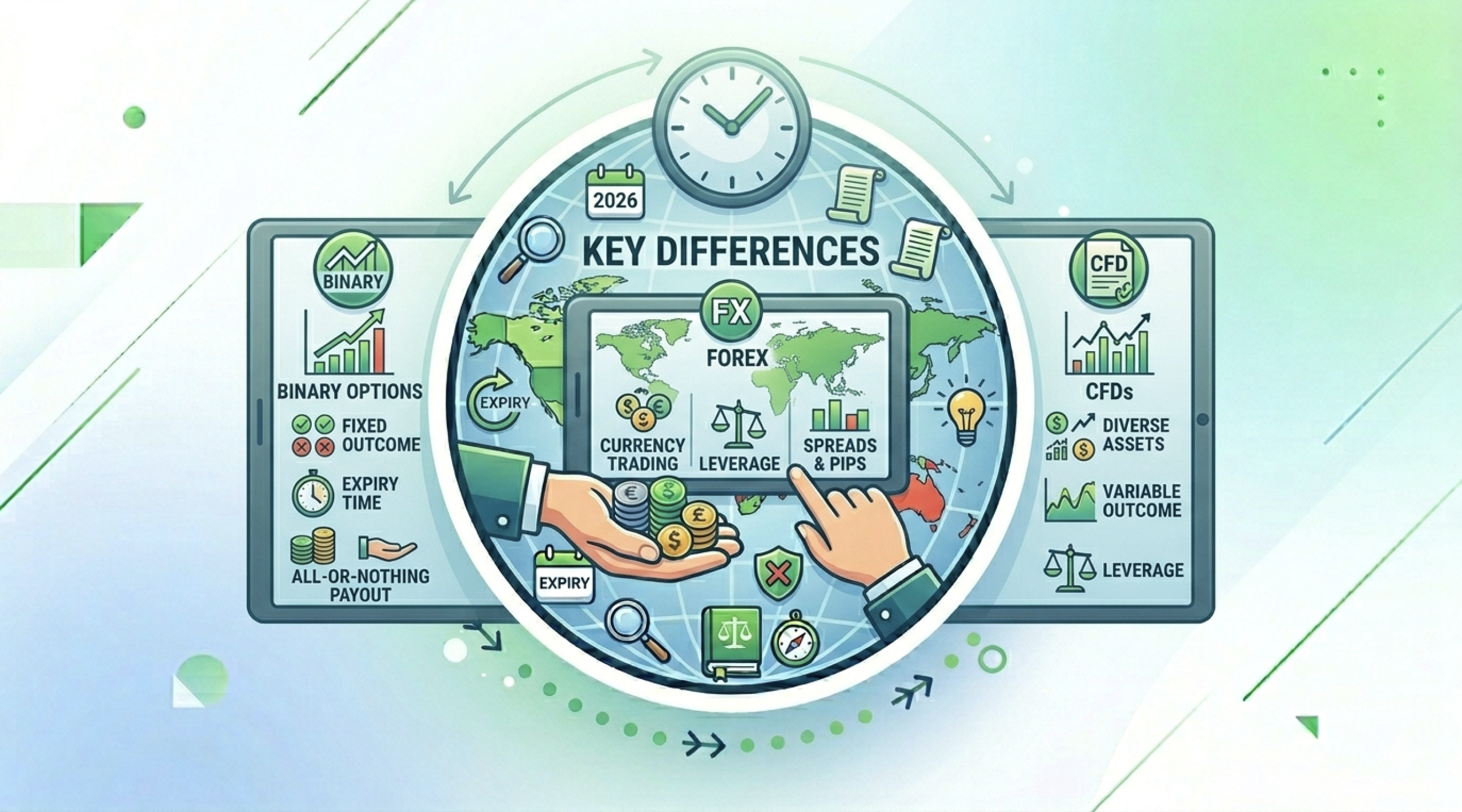
Binary Options vs Forex vs CFDs:
Which One Is Right for You?
What Each Instrument Is
Binary Options
A fixed-outcome contract. You predict whether an asset will be above or below a set price at a specific time. Win a fixed payout or lose your entire stake. No variable returns.
Forex
Buying and selling currency pairs. Your profit or loss depends on how far the price moves, not just the direction. You can exit at any time and control position size precisely.
CFDs
Contracts for Difference. You trade the price movement of any asset — stocks, indices, oil, gold — without owning it. Similar mechanics to forex but across a broader range of markets.
Head-to-Head Comparison
| Criterion | 🎯 Binary Options | 💱 Forex | 📊 CFDs |
|---|---|---|---|
| How profit is calculated | Fixed percentage (e.g. 85%) regardless of how far price moves | Depends on pip movement × lot size — the further it moves, the more you make | Depends on price movement × number of contracts — variable, like forex |
| Maximum loss per trade | 100% of stake | Defined by stop-loss | Defined by stop-loss |
| Can you exit early? | No (most platforms) | Yes — anytime | Yes — anytime |
| Minimum entry capital | From $1–$5 | From $50–$200 typically | From $100–$500 typically |
| Leverage available | None — stake is fixed | Up to 1:500 (offshore) | Up to 1:500 (offshore) |
| Trade duration | 30 seconds to 4 hours (fixed) | Seconds to months (flexible) | Seconds to months (flexible) |
| Assets available | Forex, indices, commodities, crypto | Currency pairs only | Forex, stocks, indices, commodities, crypto, bonds |
| Regulation quality | Mostly offshore / unregulated | FCA, CySEC, ASIC widely available | FCA, CySEC, ASIC widely available |
| Legal status | Banned: EU, UK, AU, US | Legal worldwide (regulated) | Legal worldwide (most markets) |
| Islamic / swap-free | N/A — no overnight positions | Available at most brokers | Available at most brokers |
| House edge / broker advantage | Built-in via payout structure | Spread + commission (transparent) | Spread + commission + overnight fee |
| Learning curve | Low — simple mechanics | Medium to High | Medium to High |
| Long-term profitability | Difficult — negative expected value | Possible with edge and discipline | Possible with edge and discipline |
The Most Important Difference
The fundamental distinction between binary options and the other two instruments comes down to one concept: how your profit or loss is determined.
In forex and CFD trading, your result scales with the size of the price movement. If you buy EUR/USD and the price moves 50 pips in your favour, you make more than if it moves 5 pips. You can also cut your losses by exiting a losing trade before it hits your stop-loss. The outcome is variable — and that variability is something skilled traders can exploit.
In binary options, none of that applies. Whether EUR/USD moves 5 pips or 500 pips above your strike price at expiry, your payout is exactly the same. And whether it finishes 1 pip or 100 pips below your strike, your loss is exactly the same: your entire stake. The price movement is completely irrelevant — only the direction at the precise moment of expiry matters.
Why This Matters for Profitability
In forex and CFD trading, a skilled trader can be right only 40% of the time and still be profitable — because their winning trades are larger than their losing ones. In binary options, that strategy is impossible. Every win pays a fixed amount, every loss costs your full stake. Mathematical profitability requires a win rate above 54–56% regardless of trade management skill.
Same Market, Three Different Outcomes
Let’s use a single real-world scenario to illustrate how differently each instrument would handle the same market event.
Scenario: You believe the price of Gold (XAU/USD) will rise over the next hour. Current price: $2,350.00. You commit $200 to the trade. Gold rises to $2,358.40 — a move of +$8.40, or +0.36% — then falls back slightly to $2,354.00 after an hour.
You buy a CALL binary option on XAU/USD at $2,350.00, expiry 1 hour, stake $200, payout 82%.
At expiry, Gold is at $2,354.00 — above the strike price. Your direction was correct.
Total account credit: $364
You buy 0.1 lot of XAU/USD at $2,350.00. At 0.1 lot, each $1 move = $10 profit/loss. You set a stop-loss at $2,344.00 ($60 max loss).
You close at $2,354.00 — a $4.00 move in your favour.
Max risk was $60. You chose when to exit.
You buy 2 CFD contracts on Gold at $2,350.00 ($100 margin per contract). Each $1 move = $2 profit/loss. Stop-loss at $2,342 ($16 max loss).
Gold hits $2,358.40 and you close manually for maximum gain.
Smaller in dollar terms but proportional to margin used.
Same trade. But this time Gold finishes at $2,349.80 at expiry — just 20 cents below your strike. Direction was incorrect by a fraction.
20 cents cost you $200. No partial loss possible.
Key Observation
In the binary option loss scenario, Gold moved barely 20 cents against you — yet you lost your entire $200 stake. In a forex or CFD trade with a stop-loss set $6 below entry, the same 20-cent adverse move would have cost you less than $1. This illustrates why position management tools matter enormously, and why binary options offer no equivalent protection.
How Risk Is Structured in Each Instrument
Binary Options Risk
Risk in binary options is deceptively simple on the surface: you can never lose more than your stake on a single trade. But the structure creates a hidden disadvantage. Because every losing trade costs your full stake while every winning trade returns less than your stake as profit (due to the sub-100% payout), the risk-reward ratio is inherently negative. There are no tools to reduce this — no stop-losses, no partial exits, no position sizing that changes the outcome once the trade is open.
Forex Risk
Forex offers the most complete set of risk management tools of the three instruments. You can define your exact maximum loss before entering a trade by placing a stop-loss order. You can move your stop-loss to break even once the trade is in profit. You can take partial profits. You can scale your position size precisely based on your account balance and risk tolerance. The risk is variable and controllable — which is why forex is considered a more serious instrument for professional traders.
CFD Risk
CFD risk mirrors forex in its structure — stop-loss orders, position sizing, and partial exits are all available. The additional complexity compared to forex is the overnight financing fee (swap), charged when holding a leveraged CFD position past the daily close. On heavily leveraged positions held for multiple days, these fees can meaningfully erode profits. Most brokers offer swap-free Islamic accounts to address this for Muslim investors.
Which Instrument Suits Which Trader?
There is no universally „best” instrument — the right choice depends on your experience, capital, goals, and how you want to engage with markets. Here is a direct breakdown.
Demo only at first
Can You Trade All Three at Once?
Many brokers — including IQ Option — offer binary options, forex, and CFDs from a single account. Using more than one instrument is not just possible; for certain traders it makes strategic sense.
A common approach among traders in emerging markets is to use binary options as a low-capital, high-frequency learning environment — building market intuition, testing directional strategies, and developing discipline — while simultaneously running a smaller forex account with a longer-term approach and full risk management tools. The two serve different purposes and do not need to compete with each other.
What does not work is treating binary options as a substitute for learning proper forex or CFD trading. The skills do not transfer cleanly: binary options reward pure directional prediction, while forex and CFD trading reward risk-reward management, position sizing, and trade management — which binary options simply do not train.
The Smart Progression
Start with binary options on demo to understand how markets move and build intuition about direction. Then open a forex micro account ($50–$100) and focus on learning risk management, stop-losses, and position sizing. Once consistent on forex, add CFDs to diversify into other asset classes. This path develops real skills rather than dependence on a single simplified instrument.
⚠ Risk Warning
All three instruments — binary options, forex, and CFDs — are high-risk and not suitable for all investors. The majority of retail traders lose money across all three. Binary options carry an inherent negative expected value due to payout structure. Forex and CFDs carry the risk of losses exceeding your initial deposit when leverage is used.
Binary options are banned in the EU, UK, Australia, and other regulated markets. Always verify the legal status of any instrument in your country before trading. Never invest money you cannot afford to lose entirely.