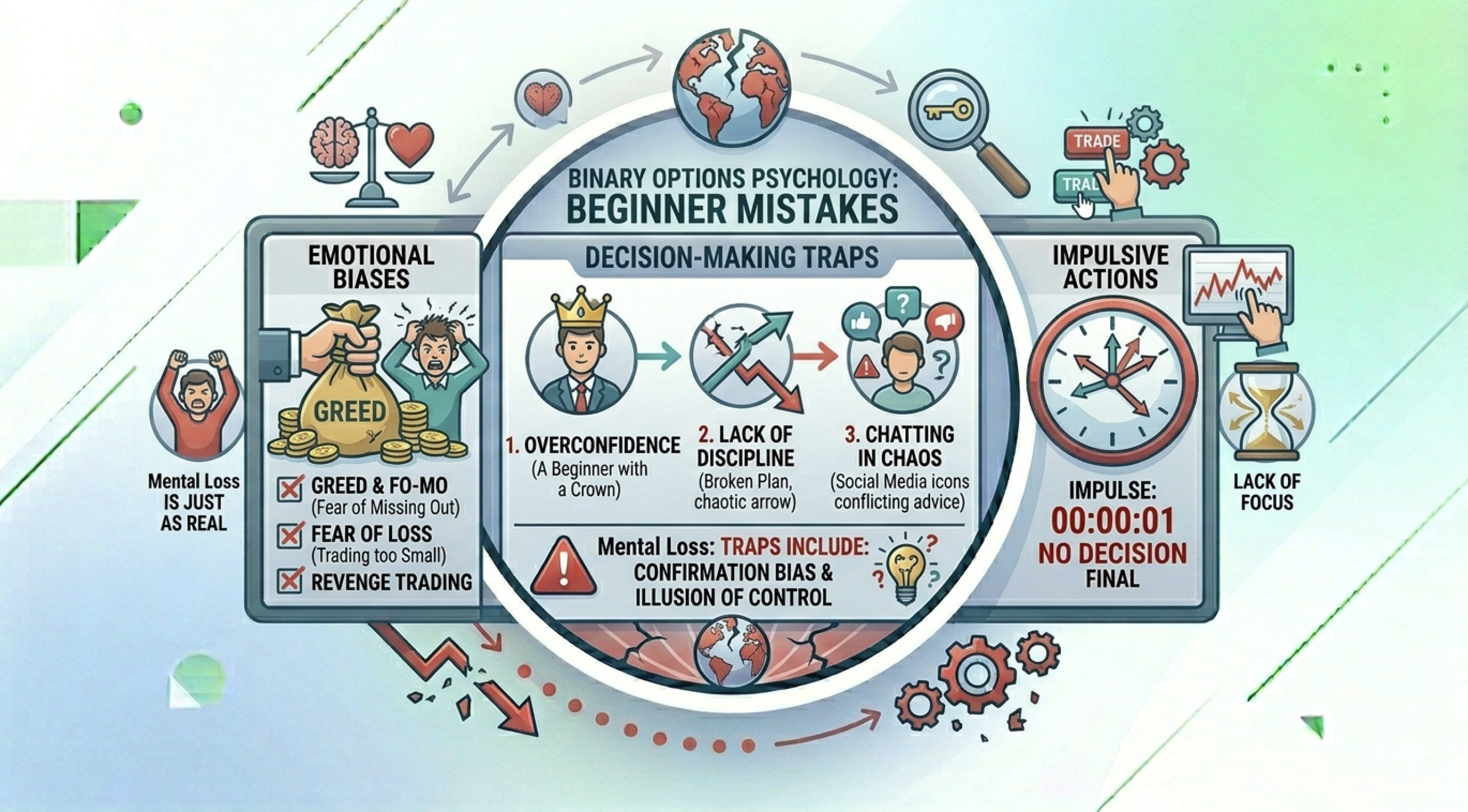
Revenge trading is the single most destructive pattern in retail binary options trading — and almost every beginner falls into it within their first session. The sequence is always the same: you lose a trade, you feel the sting of that loss acutely, and your immediate impulse is to open another trade right away to recover the money. Not because the market has given you a new signal. Not because your system says to enter. But because you want the loss reversed as quickly as possible.
You stake $20 on a CALL. The trade expires out of the money. You immediately stake $40 on the next trade — twice the amount — with less analysis and more urgency. That loses too. You stake $80. Within ten minutes you have lost $140 trying to recover a $20 loss. Your account is down 28% and every trade you opened was worse than the last.
The psychological mechanism behind this is loss aversion — one of the most well-documented biases in behavioural economics. We feel the pain of a loss approximately twice as intensely as we feel the pleasure of an equivalent gain. A $20 loss feels urgently wrong in a way that a $20 gain never feels urgently right. That urgency drives impulsive action, and impulsive action in a market with a built-in house edge is always expensive.
After every losing trade, enforce a mandatory pause of at least five minutes before opening the next one. During that pause, close the trade ticket entirely. Ask yourself: does my system give me a valid entry signal right now? If the answer is not an unambiguous yes, do not trade. The market will still be there in ten minutes. Your account balance may not be if you rush.
After three, four, or five winning trades in a row, something changes in the beginner’s mind. The wins feel like confirmation of skill rather than the statistical variance they almost certainly are. Confidence becomes overconfidence. Trade frequency increases. Stake sizes grow. The careful analysis that preceded those winning trades gets replaced by an assumption that „I know how this works.”
This is the hot-hand fallacy — the mistaken belief that a streak of successes predicts future success. In binary options, a five-trade winning streak at 50% true win probability happens by chance alone roughly 3% of the time. It is not rare. It does not mean anything. But emotionally, it feels like validation — and that feeling is dangerous.
Monday: you win four trades in a row on $10 stakes. You feel invincible. Tuesday: you raise your stakes to $50 because „I clearly have an edge.” You lose three in a row. You have now lost in two sessions what you gained in five. The winning streak did not represent skill. The overconfidence that followed it did represent a very expensive lesson.
Your stake size should be determined by a rule — for example, 2% of current account balance — not by how your recent trades went. After a winning streak, resist the urge to increase stakes. A winning run will eventually revert toward your actual win rate. If you have inflated your stakes before that reversion, the losses will be proportionally larger.
Confirmation bias is the tendency to search for, interpret, and remember information in a way that confirms what you already believe. In trading, it manifests like this: you feel that the market is going up, so you look at the chart and notice only the bullish signals — the higher low, the green candle, the rising moving average. You unconsciously ignore the resistance level directly overhead, the bearish divergence on the RSI, and the fact that the overall trend is down.
The result is not analysis — it is rationalisation. You are not reading the chart to understand the market. You are reading the chart to justify the trade you already want to open. The decision has been made emotionally; the chart is being used to dress it up as technical analysis.
The single green candle that looks like a bounce. The support level that’s „holding.” The moving average that’s „curling up.”
The three consecutive bearish candles before it. The resistance ten pips away. The overall downtrend on the higher timeframe.
Before opening any trade, actively argue the opposite side. If you want to open a CALL, spend 60 seconds listing every reason to open a PUT instead. If the bearish case is stronger than you thought, do not trade. This deliberate devil’s advocate practice forces genuine analysis rather than confirmation-seeking — and it only takes one minute per trade.
Fear of Missing Out (FOMO) is as real in trading as it is in social media. You watch the price rise steeply for thirty seconds and the emotional pull to join the move is intense. „It’s obviously going up — I need to get in now.” You open a CALL at the top of a fast move, setting your strike at the worst possible level — just as the move is running out of momentum and reverting to the mean.
In binary options, chasing is particularly costly because your strike price is locked at entry. An entry made at the beginning of a move has a strike at a sensible level relative to the direction. An entry made mid-move has a strike that requires the price to sustain an already-extended level — or push further — just to expire in the money. The probability of winning has fallen significantly; the payout has not changed to compensate.
EUR/USD rises 20 pips in 45 seconds. You open a CALL at the high, strike 1.08520. The price immediately stalls and retreats — the move was a spike, not a trend. At expiry, EUR/USD is at 1.08490. You lose. A trader who waited for the retrace and entered at 1.08460 on the bounce wins the same trade you lost.
Only trade setups, not moves. A setup is a defined condition that exists before significant price movement — a price at support, a breakout from consolidation, a signal at a moving average. If a move has already happened, it is too late to trade that move. Wait for the next setup. There will always be another one.
The individual mistakes above do not exist in isolation — they chain together in a predictable sequence that experienced traders recognise immediately and beginners fall into repeatedly. Understanding the full emotional cycle is essential to breaking it.
The cycle typically begins and ends within a single trading session. A trader who starts the morning with $200, wins two trades to reach $240, then enters overconfidence mode and loses $100 in rapid succession, then spends the rest of the session trying to recover — will often finish with less than $80. The emotional progression is almost identical across different traders, cultures, and platforms.
Set two daily limits before opening the platform: a maximum loss (stop trading when you’re down X%) and a maximum gain (stop trading when you’re up Y%). Both matter equally. Ending a profitable session early protects you from the overconfidence stage. The hardest discipline in trading is closing the platform when you are winning — but it is often the most important one.
After a losing session, most beginners engage in a remarkably consistent narrative: „I almost had that one — the price touched my level and reversed right at expiry.” „That was just bad luck.” „The signal was right but the market was manipulated.” The losses are attributed to external factors — bad luck, broker manipulation, timing — while the wins are attributed to skill and good analysis.
This selective memory serves an emotional purpose: it protects self-image. But it is catastrophic for improvement. A trader who genuinely believes their losses are bad luck and their wins are skill has no motivation to change their approach — because in their internal narrative, the approach is working. They are simply waiting for the luck to improve.
Keep a trade journal. Record every trade: asset, direction, expiry, entry reason, result, and a post-trade note about what you were thinking. After 30 trades, review it honestly. How many of your „bad luck” losses were actually poorly analysed setups? How many of your wins had a genuine rationale versus a gut feeling that happened to work? Data is the antidote to selective memory.
Perhaps the most dangerous psychological state a binary options trader can be in is trading with money they need. When the trading capital represents rent, school fees, or savings that cannot be replaced, every trade carries a weight that distorts every decision. The trader cannot afford to lose — so they cannot trade with the detachment that rational decision-making requires. Losses produce panic. Wins produce relief rather than satisfaction. The emotional pressure is constant and corrosive.
This situation is particularly common in markets where binary options are marketed as an income opportunity — promising financial independence, passive income, and freedom from employment. These claims are rarely made by the platforms themselves but proliferate through the affiliate and signal-seller ecosystem that surrounds them. The result is traders who have deposited money they could not afford to lose, under the impression that a profitable return was likely.
The Psychological Reality
Professional traders — across all asset classes, not just binary options — consistently report that their best trading occurs when they are emotionally indifferent to the outcome of any individual trade. This indifference is only possible when the capital at risk is genuinely discretionary. If a losing trade would meaningfully affect your life, you are not in a position to trade rationally. The market will expose that immediately and expensively.
Define your trading capital as money you have mentally written off. Not borrowed money. Not savings. Not money with another purpose. If losing the entire amount would cause you genuine financial hardship, reduce the amount until losing it would not. The emotional liberation that comes from trading with money you can genuinely afford to lose is one of the most underrated advantages in retail trading.
Honest Self-Assessment — Are You Making These Mistakes?
Before your next trading session, work through this checklist honestly. These are not questions about market knowledge — they are questions about your psychology and habits.
The Bigger Picture
Every mistake listed in this article has the same root: emotion overriding system. The market does not care about your losses, your expectations, or your financial needs. It will not „give back” what you lost. The only edge available in binary options is a small statistical one that requires calm, consistent, disciplined execution across many trades. Anything that disrupts that execution — urgency, fear, greed, overconfidence — eliminates the edge entirely and turns the house advantage into a certainty rather than a probability. The traders who last the longest in this market are not the most analytical. They are the most emotionally controlled.
⚠ Risk Warning
Binary options are high-risk speculative instruments. Improved psychological discipline does not eliminate the structural house edge built into payout rates. The majority of retail traders lose money regardless of their approach. Never trade with money you cannot afford to lose entirely. Always begin on a demo account before using real funds.