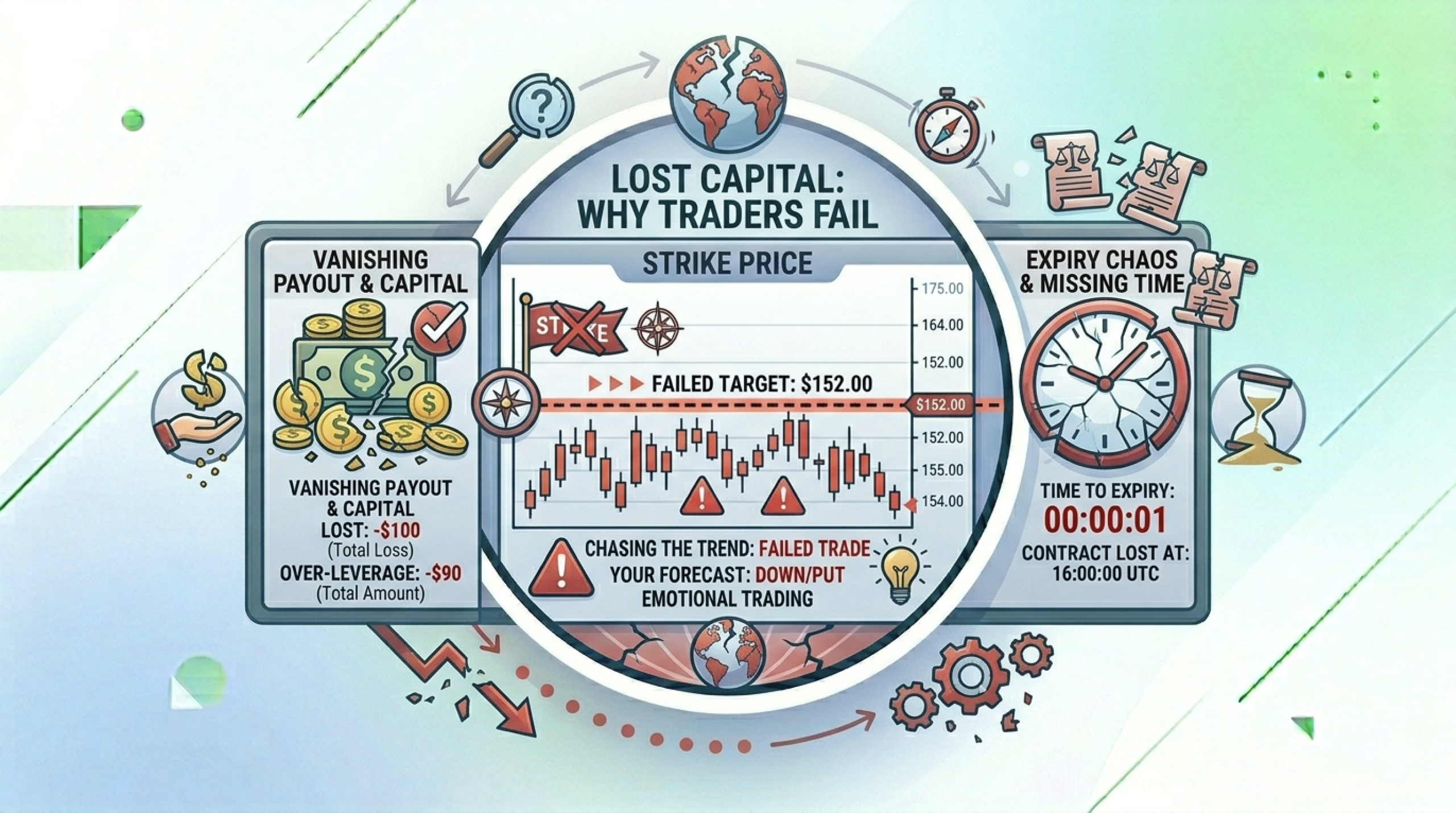
This is the foundational reason — and it exists before a single trading decision is made. On a standard binary option with an 85% payout, you risk $100 to potentially win $85. That asymmetry means that even with a perfect 50/50 win rate — which would be the mathematical expectation in a fair game — you would steadily lose money over time.
Every broker builds this margin into every trade. The percentage varies — Quotex advertises payouts up to 98% on some assets, others cap at 75–80%. But the principle is always the same: wins pay less than losses cost. The broker profits from the spread between those two numbers across all trades placed on its platform, regardless of market direction.
Always trade the assets and expiry times with the highest available payout rates. Even a 5–10% difference in payout meaningfully lowers the win rate required to break even. On Pocket Option, compare payouts across similar assets before entering — they vary more than most traders realise.
The vast majority of retail traders — particularly those just starting out — open trades based on gut feeling, recent price movement, or simple impatience. They see the price going up and open a CALL. They see it fall and open a PUT. They try to „feel” the market rather than analyse it.
This approach produces results that are functionally random — and since the payout structure already puts you at a disadvantage in a random game, intuition-based trading is a slow-motion loss of capital. A trading system — even a simple one — is a set of defined conditions that must be present before a trade is opened. It forces discipline, creates consistency, and makes it possible to measure whether an approach actually works over time.
Without a system, there is no feedback loop. You cannot tell whether a losing run is bad luck or bad strategy. You cannot improve what you cannot measure. You cannot build the edge you need to overcome the payout disadvantage.
Define your entry rules before opening a single live trade. At minimum: which asset, which indicator or chart signal triggers a CALL or PUT, which expiry time, and what payout threshold you require. Write it down. Test it on a demo account for at least two weeks. Only trade live when your system produces a win rate above 55% consistently on demo.
Loss aversion is one of the most well-documented phenomena in behavioural economics. Humans feel the pain of a loss approximately twice as intensely as they feel the pleasure of an equivalent gain. In binary options — where each trade is a complete win or complete loss — this psychological response is triggered constantly and intensely.
The result is a pattern that destroys more trading accounts than any other single factor: loss chasing. After a losing trade, the emotional impulse to immediately recover that loss leads to opening the next trade faster, with a larger stake, on a worse setup, with less analysis. The losses compound. The stakes escalate. The analysis deteriorates. The account drains.
„The trader who opened five calm, disciplined $10 trades in the morning and the trader who opened fifteen desperate $50 trades trying to recover in the afternoon are not the same person — but they are often the same account.”
Martingale strategies — doubling your stake after each loss in an attempt to recover — are particularly dangerous in binary options. Because trades can form losing streaks of five, six, or more in a row even with a 50%+ win rate, the required stakes escalate to account-destroying levels very quickly. A $10 base stake following five consecutive losses at a doubling rate requires a $320 trade just to recover — and if that trade loses too, the account is likely gone.
Set a maximum daily loss limit before you open your trading platform — for example, 10% of your account balance. The moment you hit it, close the platform and stop for the day. No exceptions. Never increase your stake to recover a loss. Your stake size should be determined by your account balance, not by your emotional state.
Sixty-second options are the most popular format among new traders and the most dangerous. At expiry times of 30–60 seconds, price movements are dominated by microstructure noise — the random, chaotic tick-by-tick fluctuations that have nothing to do with any market trend, pattern, or fundamental factor. No indicator, no chart pattern, no news event gives a reliable edge at this timeframe. The outcome is essentially a coin flip.
And yet the appeal is obvious: the feedback loop is immediate. You know within a minute whether you won or lost. This creates a dopamine-driven trading pattern that resembles slot machine behaviour more than disciplined market analysis. Many traders open dozens of 60-second trades per session, compounding the house edge over and over in rapid succession.
The mathematics are unforgiving. At an 85% payout, 20 trades per hour, the broker’s edge is applied 20 times per hour. Even a player with a genuinely positive edge struggles against this volume — and most traders do not have a positive edge on 60-second charts.
Use a minimum expiry time of 5 minutes and ideally 15 minutes or longer. At these timeframes, technical analysis — support and resistance levels, moving averages, trend lines, indicator signals — begins to carry meaningful predictive weight. Limit yourself to a maximum of 5–10 trades per session. Fewer, better-analysed trades almost always outperform high-frequency, impulsive ones.
Even traders with a genuine edge can blow their account through poor money management. In binary options, where each losing trade removes your entire stake, the risk of ruin from stake sizes that are too large is very real. If you consistently risk 20–30% of your account on a single trade, a modest losing streak of four or five trades — which will happen to everyone, regardless of skill — will destroy the account before the edge has any chance to play out.
The 2% rule — never risking more than 2% of your total account balance on a single trade — is a standard money management guideline in professional trading and applies even more forcefully to binary options, where the downside of each trade is always 100% of the stake. At 2%, a losing streak of five wipes out approximately 10% of your account — painful but survivable. At 25%, the same streak is potentially catastrophic.
Calculate 2% of your current account balance before every trading session. That is your maximum stake for each trade. If your account falls, your stake falls proportionally. If it grows, your stake grows proportionally. This approach keeps you in the game long enough for your edge — if you have one — to manifest across a meaningful sample of trades.
The secondary industry around binary options trading is enormous — and largely predatory. Telegram groups, WhatsApp channels, YouTube channels, and social media accounts promising „guaranteed signals,” „VIP strategies,” and „90% win rate systems” proliferate across Africa, Asia, and the Middle East targeting exactly the traders most likely to be new to the market and most vulnerable to unrealistic promises.
The business model of most signal providers is straightforward: they earn affiliate commissions when you register with a broker through their link. Whether you win or lose on the signals is irrelevant to their income. Some signal providers deliberately show cherry-picked winning screenshots while hiding the losing trades. Others copy-paste signals from other channels without ever testing them. A small number test their signals but fail to account for slippage and execution delays that make live results worse than backtested ones.
How to Identify Signal Scams
Any signal service claiming more than 70% win rate consistently, offering „guaranteed” results, selling their signals for a fee while pushing a specific broker, showing only winning trade screenshots, or requiring you to deposit a minimum amount with a linked broker is almost certainly fraudulent. Legitimate market analysts do not sell cheap signals — they trade their own capital or manage institutional funds.
Develop your own analysis skills. Use the free educational resources provided by platforms like IQ Option to learn technical analysis independently. Track every trade you take in a journal — asset, direction, expiry, payout, entry reason, result. After 50 trades, you will have more genuine insight into your own performance than any Telegram group can provide.
Major economic data releases — US Non-Farm Payrolls, Federal Reserve interest rate decisions, inflation data, central bank speeches — cause sudden, violent price movements that seem like obvious trading opportunities. Many beginners try to trade binary options directly through these events, opening large positions immediately before or during announcements.
The reality is more complicated. In the seconds around a major data release, prices can spike in both directions before settling on the actual direction. Broker platforms may widen spreads, delay execution, or temporarily suspend trading on affected assets. The strike price you see when you click may not be the strike price you receive. And even if your directional prediction is correct, the initial spike may reverse within your 60-second expiry window, turning a winning setup into a losing trade.
The Safer Approach to News Events
Either avoid trading in the 15–30 minutes immediately before and after major scheduled data releases entirely, or use a longer expiry — 30 minutes or more — that gives the market time to settle after the initial spike. Check an economic calendar before each trading session to know when high-impact events are scheduled. Most trading platforms include one built in, and free resources like Forex Factory publish complete weekly calendars.
Check the economic calendar before every session. Mark the time of any high-impact (red) events for the assets you trade. Either close all active trades 15 minutes before a release and wait 15 minutes after, or consciously choose to trade longer expiries around these windows. Never use 60-second expiries during news events.
Almost every platform — including Pocket Option and Quotex — offers a free demo account with virtual funds. Many traders practice on demo, achieve a good win rate, and then immediately switch to live trading expecting the same results. They are then surprised when their live performance is significantly worse.
The reason is psychological, not technical. On a demo account, there is no emotional consequence to a loss — virtual money being deducted feels nothing like real money. When real capital is at stake, the emotional responses described earlier — fear, loss aversion, greed, revenge trading — all activate and fundamentally change how decisions are made. A strategy that works on demo because it is executed calmly and methodically will often fail on live because real-money losses trigger irrational responses that override the system.
When you transition from demo to live trading, start with the smallest possible stake — the platform minimum — regardless of your demo results. Treat the first month of live trading as a separate calibration phase. Your goal is not profit; it is discovering how your psychology changes under real-money conditions and adjusting your approach accordingly. Only scale up stake sizes after you have demonstrated consistent live results at minimum stakes.
The 8 Reasons — At a Glance
Payouts below 100% create structural negative expected value before any trade is made.
Gut-feel trading produces random results — and random results lose to the house edge.
Loss chasing and martingale strategies destroy accounts faster than any other factor.
60-second trades are functionally random noise. The house edge is applied at maximum frequency.
Stakes above 2–5% of account balance guarantee account destruction during normal losing streaks.
The signal industry is predominantly fraudulent. Affiliate commission drives recommendations, not results.
Short-expiry trades around data releases ignore execution delays, slippage, and initial spike reversals.
Real money triggers emotions that override systems. Start live trading at minimum stakes, not demo stakes.
The Common Thread
Look at the eight reasons above and you will notice that only the first one — the structural house edge — is completely outside a trader’s control. Every other reason is a behavioural or strategic choice. That means the gap between the 70–80% who lose and the minority who do not is largely a function of discipline, education, and honest self-assessment — not luck or secret knowledge. The platform does not determine your outcome. You do.
⚠ Risk Warning
Binary options are high-risk speculative instruments. Even applying the lessons in this article does not guarantee profitability. The payout structure ensures a mathematical advantage for the broker on every trade. The majority of retail traders lose money regardless of their approach. Never trade with money you cannot afford to lose entirely. Always begin on a demo account.